

The Facade
The Facade
The Facade
Audio transcription
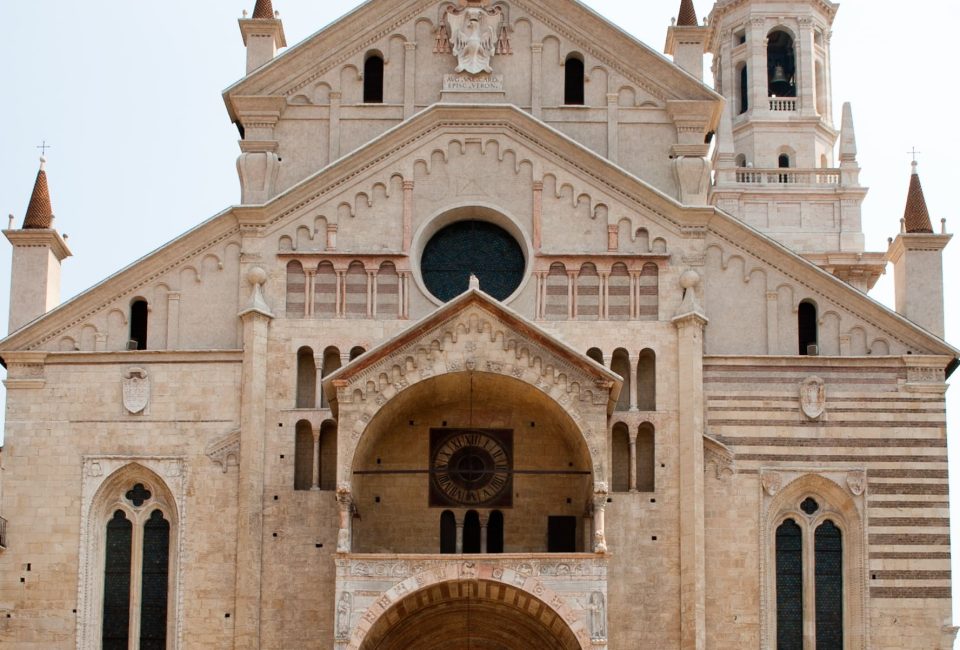
The current external appearance of the cathedral dates back to the twelfth century and was designed by master Pelegrinus and later by Nicholaus, who created the decorative elements of the façade.
The prothyrum, or small arched portico covering the entrance, has two floors. The two lower twisted columns rest on two imposing griffins in red Veronese marble, which in turn support massive architraves of the same material, on which are carved in high relief the personifications of the theological virtues of faith, hope and charity. Two male figures, one young and one old, crouch to support the weight of the vault, representing the passing of time. Inside the vault, the symbols of the evangelists can be seen, and, in the splay of the portal, ten prophets appear, unfurling long scrolls engraved with verses referring to the coming of Christ. Protecting the entrance portal of the cathedral, a little lower down, are sculptures of Charlemagne’s two paladins, Orlando and Oliviero. The polychrome lunette is carved with the Madonna and Child Enthroned, the Annunciation to the Shepherds on the left and, on the right, the Adoration of the Magi. Over the centuries, the upper part of the façade has been enriched with spires and Gothic windows, as well as some Baroque decorative elements.
On the right side of the cathedral, you can admire a beautiful lateral prothyrum, formed by two orders of architraved columns supporting an arch with a tympanum held up by a carved lion. The Romanesque capitals depict female figures on the left and lions on the right. Above, on the left, you can see the image of a woman holding two cups and a fish with a lion and birds. The supports of the upper columns depict the Stories of Jonah on the left and a lion on the right, while the two upper capitals feature the figures of the Angel, and the Virgin annunciate.
The base of the bell tower, visible on the right side of the cathedral, dates back to the Romanesque period, while the central part is from the sixteenth century and the top, without a spire, is from the early twentieth century.