

The Apse and Tornacoro
The Apse and Tornacoro
The Apse and Tornacoro
Audio transcription
The main apse is enclosed by an imposing choir screen in white, black and pink marble, designed in 1534 by the renowned architect Michele Sanmicheli. Screens such as this were built to create a separation between the people and those celebrating the liturgy.
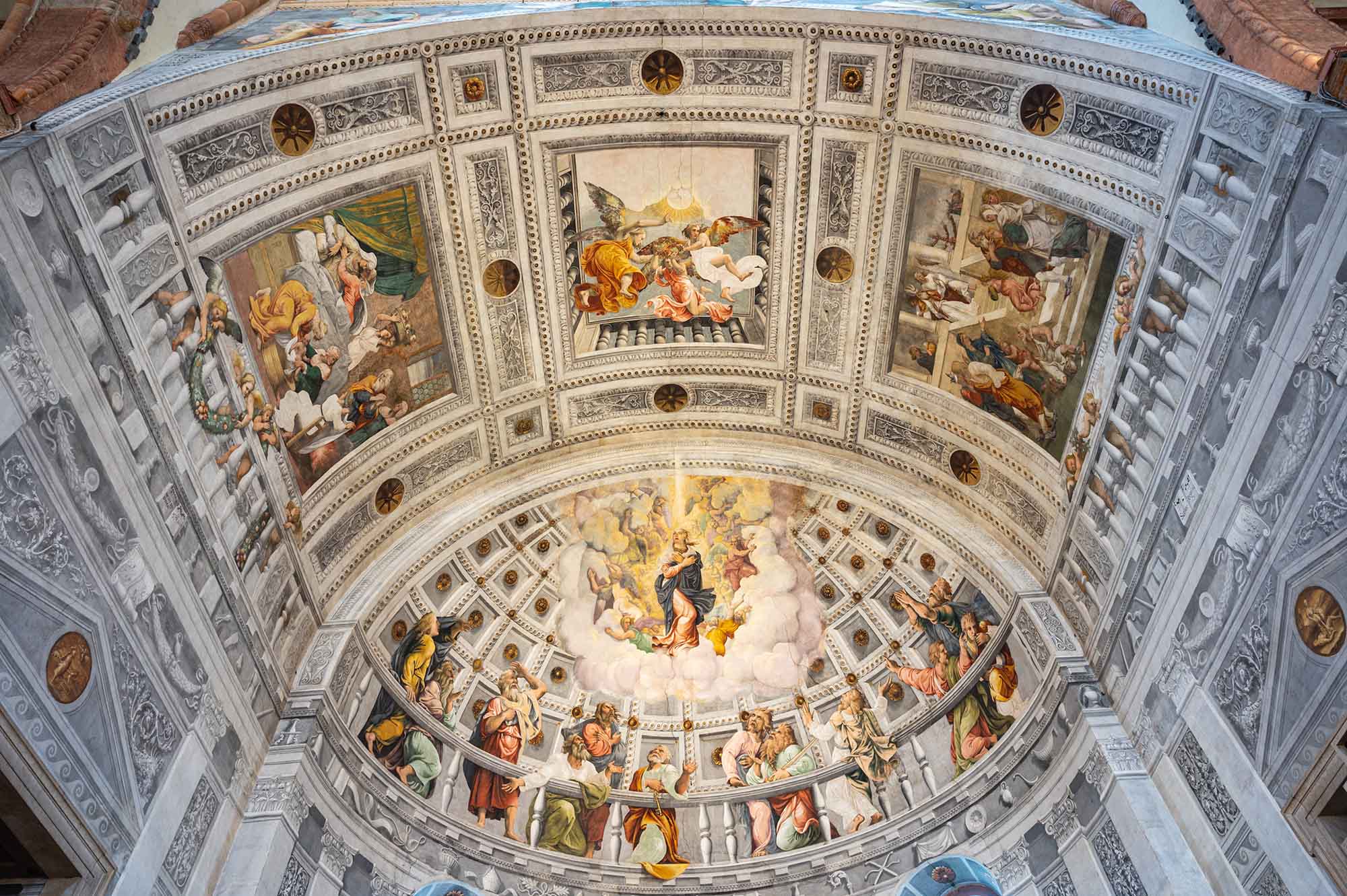
The pillars are topped with candelabra and support a cornice dominated, on the central entrance arch, by a crucifix flanked by statues of the Madonna and Saint John. The large cycle of frescoes dedicated to the Virgin was created by Francesco Torbido, who painted it after preparatory cartoons by a pupil of Raphael, Giulio Romano. In the apse, the Apostles witness the miracle of the Assumption of Mary, who, classically dressed in red with a blue mantle, ascends to the centre of the scene above a cloud surrounded by flying angels. The latter part the clouds to allow the miracle to be seen, set against a background painted to create the illusion of a real coffered semi-domed structure. In the panel on the left, on the other hand, the Birth of the Virgin is depicted. Saint Anne, covered with a sheet and assisted by a maid, lies on a canopy bed with green drapes, resting after the labours of childbirth; two midwives, kneeling at the foot of the bed, take care of the newborn baby, preparing her bath. In the square panel of the central part of the vault, we find the Annunciation of the prophets Isaiah and Ezekiel. The Virgin, dressed in red, kneels at the centre of the scene. At her sides, the two major prophets, depicted with large dark wings, speak to her, anticipating what is to come. In the last depiction, inside the right-hand segment of the arch, we see the Presentation of the Virgin in the Temple. Here, the young Mary, dressed in red and facing the priest at the entrance to the religious building, kneels on the steps of the temple in Jerusalem. The procession around includes her parents, Anna and Joachim, who have come there to present their daughter to the priesthood, as promised to God. The ancient presbyteral area was renovated at the behest of Bishop Gianmatteo Giberti, who was given the task in 1534 of providing a suitable burial place for Pope Lucius III, who died in exile in Verona in 1185, and Bishop Ludovico di Canossa. He had the apse area transformed into a sort of mausoleum. In front of the tornacoro – the semicircular choir screen – there are the ancient tombstones of bishops and cardinals, while that of Pope Lucius III is on the wall at the end of the right nave.